
A Lite Too Bright


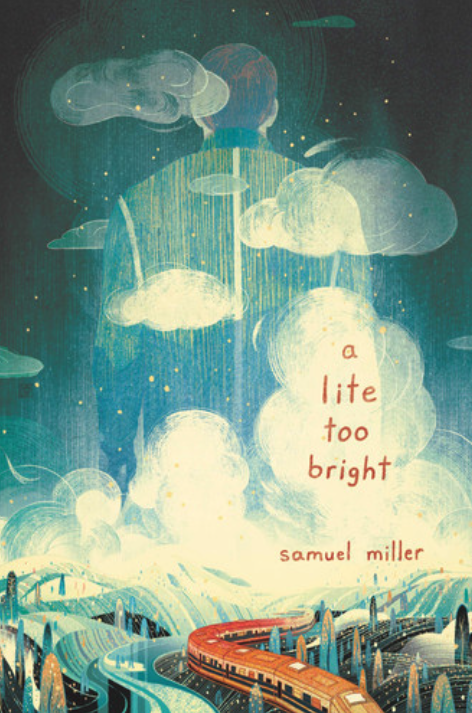
Welcome to this month’s episode of The Exploring Reader! Today, I’ll be discussing A Lite Too Bright by Samuel Miller. This contemporary novel came out in 2018 and won the ADC awards in the illustration category for that same year for its cover page. The author has also dabbed in screenwriting, but if you’ve never heard of him or this book, I’m glad to be the one introducing you to it.
The main character of this story is Arthur Louis Pullman the III. As he’s living in the attic at his aunt and uncle’s, he reminisces on his grandfather’s favourite book and finds a note with what he interprets to be a clue about the truth of the grandfather’ disappearance. His grandson sneaks out and travels across the United States by train, finding an adventure buddy in Mara, another traveller, along the way. The plot line happens in the early 2010s and with the main characters being underage, they become resourceful and use more traditional and stereotypical cross-country “road-trip” clichés like paying with cash instead of credit cards. You also find them carrying one big backpack instead of a suitcase, using paper maps as opposed to technological navigational tools, exploring all the clues while disregarding sketchy places and people they meet along the way.
I do like the genre of contemporary fiction and I think this book has some similarities with John Green books in terms of characters and plot lines. It really reminds me of Paper Towns in that an awkward and misunderstood teenage boy chases clues about someone they care about across the country. I think 3 stars is appropriate and maybe this can be the book to get you into contemporary fiction. It’s definitely a great introduction to the genre. I really liked that Arthur and Mara develop a strong friendship and that their characters connect on a platonic level and they don’t jump to immediate romantic attraction for one another. Staying on the subject of characterization, the indirect approach and the writing style of the grandfather in his works definitely engages the reader more because we have to decipher motives at the same time as the other characters. Audience engagement also makes the reader more involved with the novel. I believe Mara to be a stock character in that she’s has a rebellious personality and pushes the shy guy (Arthur in this case) to get out of his shell and dare to do things. He’d never have done. Once again, a nod to Paper Towns. A lot of contemporary novels are written in the first person point of view and it has the effect of emphasizing the themes of self-discovery and identity which fit in with modern themes we tend to see in our current lives.
I like Miller’s subtle writing mannerisms such as writing the grandfather’s poems and some parts in the novel in lowercase.
The symbolism of this novel revolves around very confusing “clues” Arthur thinks his grandpa left behind for him. This mirrors how literary analysis is subjective and our interpretation is not always correct, right? Just how Arthur doesn’t always interprets his grandfather’s writing and clues properly. I like Miller’s subtle writing mannerisms such as writing the grandfather’s poems and some parts in the novel in lowercase. I interpret it as Arthur the 1st wanting to make his story timeless since it has no beginning or ending without capital letters. It could also be a reflection of his Alzheimer’s in that he wants to write his ideas as fast as possible to not forget and therefore he abandons basic grammatical rules. I see again a connection to Paper Towns in which Margo decided to ignore these capital letter grammatical rules.
What I disliked the most about this book is the presence of all these stereotypes. Arthur, the grandson, has a lot of mental health issues like depression, low self-esteem, and anxiety. It’s good to have such representation, but it’s becoming cliché in that he believes therapy can’t help him and his parents are clueless about his feelings. They think sending him to see a professional for a few months will sort their child out. However, it’s much more nuanced than this and everyone deals with mental illness in their own way. The grandfather is this mysterious character that no one knows who he truly was and his clues are cryptic. His grandson seems to be the only one with the will to discover the truth and along the way, he discovers himself once again. Doing a better job than therapy might I add. I didn’t like how some parts of the plot dragged on for too long. Without giving it away, I must say that some clues pulled Arthur all over the place and didn’t avail to much. I know it’s supposed to reflect that such types of adventures are not always easy and the answer is never within reach but it felt too much at times.
Our own little adventure ends here. Thank you again for listening and make sure to stick around for the next review on Lessons in Chemistry by Bonnie Garmus.
Until our next literary journey, keep exploring those pages!
– reviewed on January 31, 2024