
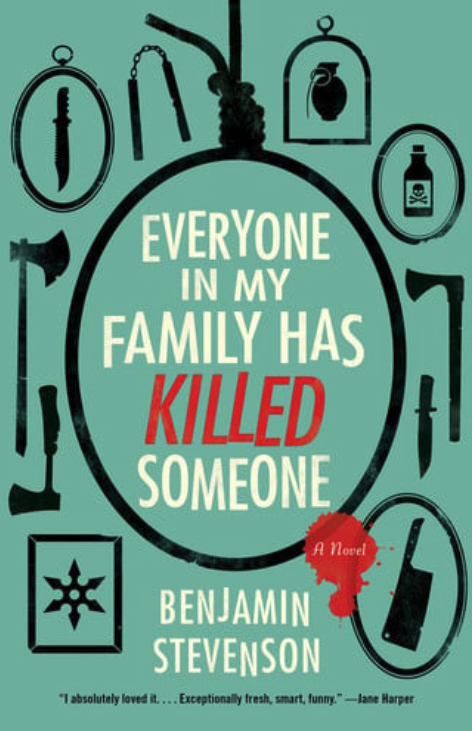
Everyone in My Family Has Killed Someone


Welcome back to The Exploring Reader! While I was planning ahead for the next book pick, I realized that me saying this episode is for the month of July is wrong. Because even if I did read this book in July, you’re probably listening to my show because you want to know if it’s worth reading! So now I’m going to correct my logic and say that today’s episode is for the month of August. I’ve read Everyone in my Family Has Killed someone in July, but now it’s up to you to decide if you want to have a go at it next month—or even later :) This murder mystery novel puts a sort of humanistic and modern spin on the detective genre. It was written by Australian comedian Benjamin Stevenson and released in early 2022. HBO even bought the rights to turn the story into a limited series.
It starts off with Ernest Cunningham, the narrator, telling us the story of his family gathering at an Australian mountain resort to celebrate his brother’s release from prison. Of course, with a family of killers and an isolated setting, someone was bound to eventually get murdered. But the dead guy isn’t someone the Cunninghams know. So Ernie, as a mystery novelist critic sets out to uncover this guy’s identity, his killer and the motive. And maybe, if he’s not too busy, Ernie can make amends with his brother for getting him locked up. Agatha Christie fans are sure to love it for it’s “closed room” narrative and crafty development.
Nowadays, a lot of entertainment content seems to be a spin off of some book, show, song, movie which in its turn is also probably a spin off. There is less and less original works of art and we can see it clearly from movie franchises that won’t stop even though there is literally nothing else to add. We can see it in songs that sample others from decades past and even TV shows. What I’m getting at is that the mystery genre is popular. A lot of crime TV shows with infinitely many seasons exist and eventually, we will have seen it all. The connection to this book is that while I do see some original elements like the writing style, the plot has a weird resemblance to Agatha Christie’s The Mousetrap. Ernest also fancies himself a bit of a Poirot, Christie’s famous French detective. He uses humour but not to get a laugh out of people nor to appear likeable. Just to prove he’s wittier. He also gathered all the characters to reveal to them the real murderer and explain the logical conclusions he reached, just as Poirot famously does in most of his stories.
I found the narration style original because of the unique combination of the breaking of the 4th wall with past tense and audience engagement.
I found it irritating when characters behaved irrationally when there was no cause for it. At one point, Ernie’s brother who went to jail, Michael, meets up with his ex-partner. She becomes unsettled and despite not being together anymore, she still acts lovingly toward him. It’s irrational what she’s doing, but it makes sense within the context and her emotional situation. They justify her behaviour. On the other hand, I got annoyed when Michael arrived at the resort and acted all normal toward Ernie. He didn’t have any spite for him and even went on to announce him as his lawyer. That’s really weird and it put me off that the ex-convict would forgive his brother that easily. I also found the amount of times the narrator tries to convince us he’s reliable very excessive. It almost feels like he’s trying to create this impenetrable honesty and credibility aura around him. Now we have to talk about the title. The Cunninghams are not part of any crime syndicate nor are they associated with any gangs. They are basically a normal family where some are lawyers, doctors, influencers, writers, etc. When the author declared the the title as “Everyone in My Family Has Killed Someone”, he was probably using it to grab our attention and make us want to pick up and buy the book. Of course, he had to make it true that every family member would kill a person. This is good and all but at times it felt to far fetched. The doctor of the family, Sophia, feels guilty for having killed someone while she was operating on them and another character feels guilty for not having been able to stop the death of some stranger. They didn’t murder them or anything. Like yes if you see someone about to be hit by a car but you don’t have time to react, it’s really not your fault that person died therefore their death should not be on your conscience and even then, you wouldn’t go to jail for that.
I found the narration style original because of the unique combination of the breaking of the 4th wall with past tense and audience engagement. Before I go on to exemplify my claim, I want to tell you what the “breaking of the 4th wall” means. MasterClass defines it as quote “the implied plane that marks the “edge” of the onstage action. Actors break the fourth wall by acknowledging the existence of the audience.” What this basically means it that a character will be conscious they are part of story and that someone not related to that story is reading or watching. It goes beyond just the first point of view where the narrator talks about their experience. They actively engage with the audience. Maybe you’ve seen it in media productions (like Fleabag) where one of the characters will interact with others and suddenly look directly into the camera at the viewer (who’s watching from a different angle). In the context of Everyone in My Family Has Killed Someone, Ernie is breaking the 4th wall because he encourages us the reader to verify the claims he makes so we may consider him as a reliable narrator. Right at the beginning of the novel he tells us which pages the murder will happen on and they actually do. He announces there are no sex scenes which is also true. But he also likes to tease us. Throughout the book, he says for example that he’ll end up “locking lips” with a certain character which he does but not in the way we think. Other good qualities of this book are that the whole story feels like an oral tale that was later written down and not like a book being read aloud. The vocabulary being different and the audience engagement give off those impressions.
September is the time of year when students head back to school and it’s time to “hit the books”. I’m also going to join in on this by reviewing The Exploring Reader’s first non-fiction novel. It’s titled Rich AF and the author is the popular social media “Wall Street girlie” Vivan Tu, or our Rich BFF. Make sure to tune in next month for an honest review about the personal finance tips she shares with us.
Until our next literary journey, keep exploring those pages!
– reviewed on July 26, 2024