
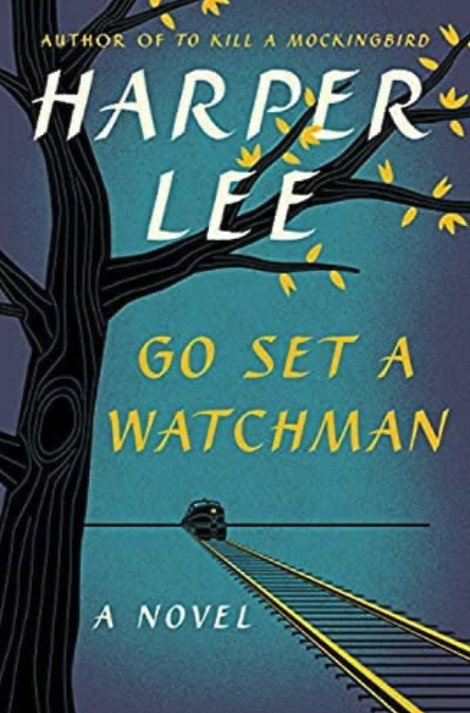
Go Set a Watchman


Here’s to the start of the second month of the year! It’s really true what people have been saying online, that January really feels like it was stretching out forever. Well, I’m not going to stretch out this month’s pick any further: I will be reviewing Go Set a Watchman by Harper Lee for you! The reason why I chose this book is that it really felt like forever since I read it. I wanted to give it a second go, see how different my perspective and understanding will have changed.
When I said Harper Lee, I’m sure you thought immediately of To Kill a Mockingbird. And Go Set a Watchman is the sequel to that timeless American classic. It was published in 2015 but Lee started work on it wayyyy before that. And by “wayyyyy before”, I mean like 1950s. The manuscript for Watchman was supposed to be the actual famous first novel. She re-worked it along the way but the publishing of this second novel, while impatiently awaited, faced many negative criticisms. Like others before me, I find that the publishing of this novel feels forced. It seems to me that Mrs. Lee was trying to get rid of all the pestering questions about other works that she eventually got fed up and put out this sequel for fans to leave her in peace. However, in a statement she released about the publishing, she expressed her happiness and contempt with Watchman. Before we dive more into an analysis of the backstory and the novel itself, let me tell you what it’s actually about!
It is set 20 years later than To Kill a Mockingbird, when the main protagonist, Jean Louise Finch is 26 and living in New York. The story starts with her regular trip to see her father and follows her as she figures out what to do with the rest of her life. Close to half-way through, a major event leaves Jean Louise baffled and rocks her foundation.
There is a lot to unpack but as I always promise no spoilers, it’s gonna be hard. The major controversy surrounding the novel is related to that major event I was just mentioning. It goes against Atticus’ (Jean Louise’s father) character that we have come to appreciate him so much and look up to in Mockingbird. I was very shocked and I do not agree with this radical characterization change Harper Lee decided to go with for Atticus. She does seem to have though this through because she lets Atticus explain himself to Jean Louise. I think the author wanted to use this event as a way for the protagonist to truly lose her innocence, but I feel it was extreme to put it out there especially in the social context of the 2010s. Had it been published closer to when she began writing it, it might have been better received. If you don’t mind spoilers, the Internet is filled with critics ready to comment, so have fun reading on. It’s also very clear that this was a first draft of To Kill a Mockingbird. Like, there’s no doubt about it because of the way the characters and introduced, repetitions are clearly there between the two novels, if not even, exact sentences. There is even some discordance between the outcome of the trial in Mockingbird, the main plot point. This is why, for me, it seems as a very weird second novel because the author decided to go in such an opposite direction and this solidifies my claim that she might have just put the novel out there without being entirely satisfied with it. There’s not much I can really add about “negative” points. Like those where the major problems I had with this sequel.
While Scout matures and sheds the childish view of the world she had in Mockingbird, she keeps her integrity, her principles.
The best thing out of the whole story was how Jean Louise, or Scout, has kept her character. While she now matures and sheds the childish view of the world she had in Mockingbird, she keeps her integrity, her principles. She remains a tomboy and still refuses to fully integrate society as a lady, as her aunt Alexandra always insists upon. She’s not afraid to call people out, to let them know they’ve strayed from their good character or that they should try to see things from a different point of view. I do feel for her because this major event basically turns everyone a bit against her. She feels abandoned, like no one is on her side. She still fights for the truth and tries her best to make sense of this situation. She is truly a wonderful character to root for throughout both novels. However, the ending seems very forced and her actions seem too opposite, too fast. She changes her mind much faster than I believe is realistic in this context.
A lot of the novel will feel like nostalgia to those who’ve read the 1960s classic. Like I said, lots of explanations about the different families of Maycomb, the Alabama county Scout grew up in. There are some nice flashbacks to the time she was a child and growing up with her brother Jeremy, or Jem. But you will never be able to shake the feeling of Watchman being a first draft to Mockingbird because there is so much mention of the past, yet the only allusions we get about Mockingbird are the Tom Robinson trial (with contradictory verdicts) and mentions of Dill, Jem and her’s childhood best friend.
I know this episode might have been shorter than you expected, and no it has nothing to do with the fact that February is the shortest month. There is just not a lot of action and most of what needs deciphering and analysis is regarding characterization and elements that are spoilers. The good news is that the book reads fast. It might be like 250 pages but if your edition is like mine, the pages are thick and the font is relatively big. Now the big question. Should you read this or not? I say yes. I’d maybe give it a 3 out 5 stars. If you were a fan of To Kill a Mockingbird, it seems like the right thing to do in order to complete the series. But most importantly, I think the main reason you should read Go Set a Watchman is to form your own opinion about the “major event”. Reviews and critics online are really dramatizing it. While I do find it grave and a “faux pas” as a plot point, it seems much worse in other reviews. These critics tend to take one small part of that event and it make the basis of their argument. Once you understand the context, to me, it’s not as bad as it seems and I believe Atticus in his explanation. I do not forgive him, but for some parts, I understand why he might have done it and like it’s mentioned at the end of the book, I see him as “human”.
And we are done for this month! Thank you for sticking around and I hope you do give this novel a try, or at least take the criticism surrounding it with a grain of salt as they say. March announces spring! Time to shift to a more light themed novel and I’d say it’s also time for second chances. We are going to talk again about Emily Henry. This time, I’m gonna be reviewing Funny Story, a romantic book about two mis-matched couples.
Until then, keep exploring those pages!
– reviewed on February 1, 2025