
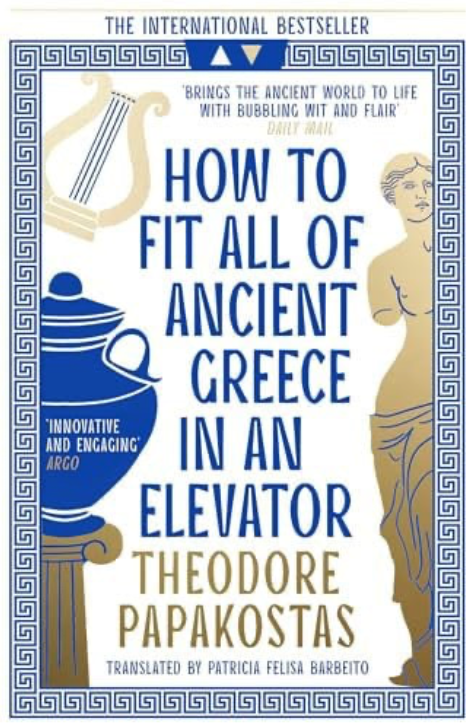
How to Fit All of Ancient Greece in an Elevator


Hello hello and welcome to the March episode! Today I’ll be talking to you about a book on Ancient Greece. It’s called How to Fit All of Ancient Greece in an Elevator so it’s safe to say this book is packed! The author, Theodore Papakostas, is an archaeologist and in this novel, he simulates an elevator conversation between himself and other guy. They both get stuck when the elevator stops working and the archaeologist walks this man and us, the reader, from the Stone Age all the way through the end of the Roman Period. The novel was originally published in Greek in 2021 and was translated to English in 2024. I think the publication date for this novel is the most important to remember from all the books we have previously covered here on the Exploring Reader. This is because we are dealing with history that is continuously evolving as new discoveries are brought forward. The narrator himself mentions this ever-changing nature to archaeology and how corrections are a common occurrence. So depending on when you’re reading this book, keep in mind not all the info might be the latest out there. That is to say you should go into this novel with the mindset of learning and understanding the complexities of our history, but to also remember that some facts may change given that’s it’s been already 5 years since the publication.
So what does the plot actually look like? It’s really just the narrator going into an elevator with another guy, the thing stops, and they strike up a conversation about what they do, with the emphasis put on the narrator’s career as an archaeologist. Each chapter explores a different period and ends with a FAQ about common questions people have on the field of archeology. The author explains all this in his note at the beginning of the book. For anyone curious about the chapters, you will explore the Stone Age, the Cycladic Culture, the Minoan and Mycenaean Civilizations, the Dark Ages, the Geometric Age, the Archaic Period, the Greco-Persian Wars, the Classical Period (what we commoners think of when someone says Ancient Greece), the rule of Alexander the Great, the Hellenistic Period, and finally the Roman Period. Bear in mind that each period is connected to Greece’s history.
I love the drawings at the beginning of each chapter, putting us into context about what’s to come.
The thing that first attracted me to the novel (besides the elegant cover) was the possibility of exploring the history behind Greek mythology. I love Ancient Greek myths and religion so I though this book would offer some explanation on how those myths came to be and how they evolved over the centuries. I will say that I am a bit disappointed by how little they were covered, but I do not blame the author. The novel is only 275 pages which is an insanely small amount of space to dedicate to all these historical periods. Obviously, it will feel like time is flying and that the narrator is skipping over so many details. He admits that himself, but this shorten version makes sense given the fact that it’s supposed to be an elevator conversation and that it’s supposed to be understood by the everyday person. Another positive point: I like the FAQ sections at the end of each chapter that allows us to get a bit of info on the very misunderstood discipline that is archaeology. And that was the author’s intent as well. I love the drawings at the beginning of each chapter, putting us into context about what’s to come. Toward the end of the novel, we also get some extra drawings about different historical objects and I wished we could have had more drawings or at least visual representations about the different elements mentioned through the novel, it would have really added to the experience.
On the downside, this book is not for people who don’t like history. It’s very condensed, intense, and fast paced. It’s not hard to understand, it’s just hard to memorize all the information. And the problem is that when a new element is introduced, more questions arise that don’t have the time in the novel to be explored. The characters acknowledge this and I must say that it’s really showing the author’s scientific way to thinking. He is very persuasive in his writing, acknowledging the limitations of his work and that makes it all the more interesting and credible. This lack of time to cover all elements also gives the reader the opportunity to explore what attracts them on their own time.
So in a nutshell, if you love history, you’ll love this novel. If you hate history, you get very overstimulated by the rapid succession of information.
I still think you should give this novel a chance no matter what, it’s a great way to learn. Much better than sitting on a stuffy afternoon in a boring history class. The way the information is presented is through conversation. Both characters add their thoughts and opinions. It’s not just the archaeologist monopolizing the conversation and only sticking to facts. He brings his own unproven theories and personal preferences about each historical period.
We are at the end of today’s episode, thank you for listening. Hopefully How to Fit All of Ancient Greece in an Elevator by Theodore Papakostas will add some diversity in your TBR. In April, we will be looking at Six of Crows by Leigh Bardugo So make sure to follow the Exploring Reader on any platform you get your podcasts to stay up-to-date on the latest episodes.
Until next time, keep exploring those pages!
– reviewed on March 1, 2026