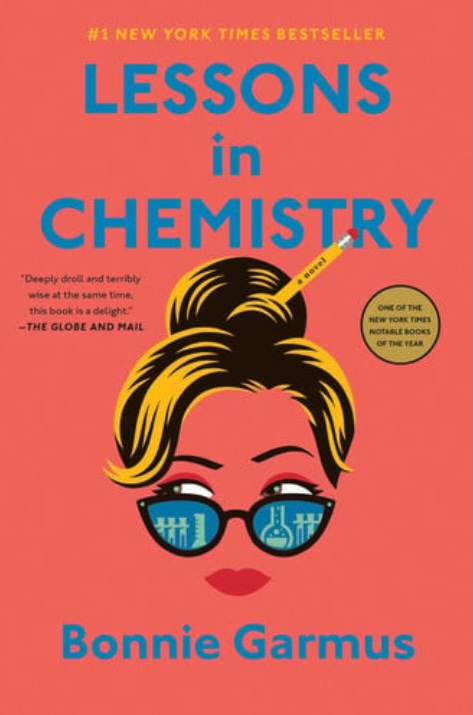
Lessons in Chemistry


Hello dear listeners! To stay on topic with the month of love, I wanted to talk about a book that has become dear to my heart and that encapsulates the theme of love in a distinctive way. February’s episode is on Lessons in Chemistry by Bonnie Garmus. The end of the awards season is right upon us so maybe you’ve had a chance to discover this wonderful story through the Apple TV+ series starring Brie Larson.
The book itself has won, among many awards, the Book of the Year by Barnes and Nobles and the International Book of the Year at the Australian Book Industry Awards.
While the title may give off the feeling of reading a chemistry textbook, the content is entirely different. The story follows Elizabeth Zott, a lab technician working at Hastings Research Institute in the 1950s and 1960s. Seeing that she only has a Master’s degree in chemistry, she is completely undervalued at work. Only brilliant but introverted and unconventional chemist Calvin Evans sees her true talent and intelligence. They begin dating and working together on the theory of abiogenesis. For you non scientific readers like me, it is the theory that life was derived from non-living matter. One morning, Elizabeth must face the biggest change in her life and discover that her talent might lie in her own personal lab: the kitchen.
She doesn’t just try to encourage women to fight for their rights; she cannot stand the unscientific reasoning behind gender inequality.
Lessons in Chemistry is such an excellent book, first in terms of main character development. The evolution and growth Elizabeth experiences is slower, or at least, not as pronounced. I think that her strong and resilient nature is what makes her so easy to root for. I believe her appeal lies in her consistent treatment of other characters. She sticks out amid the social climate of her time because she doesn’t just try to encourage women to fight for their rights; she cannot stand the unscientific reasoning behind gender inequality. It was wonderful to see how much impact she had on secondary characters like Fran Frask who I believe serves as her foil.
While I do believe this book should be judged by itself, I cannot omit to mention the striking difference between the novel and the TV show when it comes to the Sloane family. Garmus decided to portray the patriarch as a disrespectful and inconsiderate husband. This does seem to correspond with the gender roles acceptable at the time. However, I didn’t like how it transformed Harriet and made her spiteful of Elizabeth at times. In the TV show, the Sloanes are African American. This gave the show writers the opportunity to display multiple battles for equality. I also like the show better in this aspect because Harriet was a lawyer and she wasn’t just a nosey neighbour. Nonetheless, she was portrayed in both works as a hardworking mother and a person who has suffered a lot of injustice.
I liked that the narrator was omnipotent and used the third person point of view. I really think it makes the storytelling more objective and it allows us as readers to see the true contrast between the women and the men’s thoughts. It made them unfiltered and elicited more reactions. For example, I was really frustrated when reading how Dr. Donatti perceived Elizabeth. He admits she’s intelligent and deserves recognition for her hard work. Yet he still minimizes and disrespects her. For these reasons, I give Lessons in Chemistry 4 out of 5 stars.
The novel has many complex themes of love, self-esteem, inequality, and power dynamics.
The author’s creativity can be seen in the plot through her shifting of events. Instead of having a linear storyline and occasionally adding some flashbacks, she jumps at different points in time in Elizabeth’s life. While this may seem a bit more chaotic and unstructured, I think it allows Garmus the freedom to add explanations to certain scenes and it makes for a clearer picture. For example, while Elizabeth’s daughter Mad is doing a family tree assignment at school, we have a few chapters explaining her father’s childhood and his connection to a particular man who helps Mad oblivious to who her father is. I think the background we get on Clavin in those chapters is too long to be considered a flashback so I see it more as a cut in the plot to insert Calvin’s story and make it connect with his daughter’s.
To recap, this novel is not just for chemistry lovers, as it has many complex themes of love, self-esteem, inequality, and power dynamics.
Thank you for listening! Try to snag a copy as it is a wonderful read for the upcoming spring break and you’ll have no problem checking it off your TBR very fast. Feel free to subscribe and don’t miss out on next month’s episode on The Things They Carried by Tim O’Brien.
Until our next literary journey, keep exploring those pages!
– reviewed on February 28, 2024