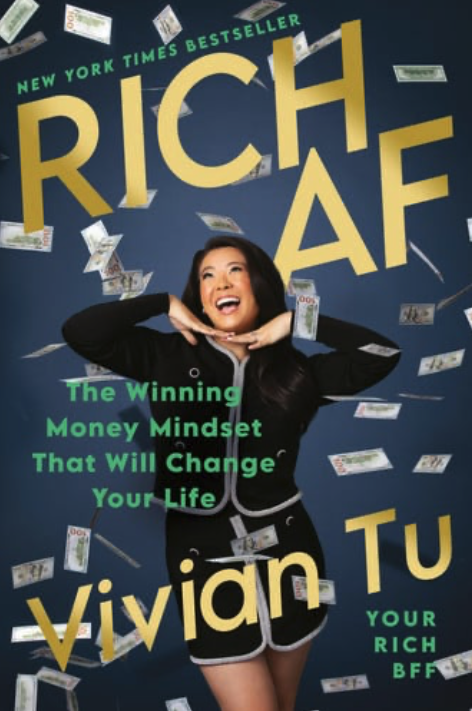
Rich AF


Are we ready to head back to school? Maybe you’re not quite ready for it so I’m here to help you ease into it with The Exploring Reader’s first non-fiction review! Rich AF by Vivian Tu will teach you true basic financial literacy notions. No matter your level of interest in finance, you should really learn how to manage your finances like budgets, credit cards, bank accounts, retirement, taxes, and investments. You don’t have to be a know-it-all, but you have to understand to a certain level what is going on. And when you have trouble, seek out professional help from experts who really are there to help. Vivian Tu is known for her quick, entertaining, and educational videos on social media. If you’re familiar with her videos, you’ll very likely enjoy this book. She released it in December of 2023 and it has been accumulating a lot of fame and praise since then.
There’s not really a plot summary, as you can imagine. Part 1, titled «You work hard for the money» is about your earnings, career, and budgeting. Part 2 delves into savings, investing, retirement, credit cards, and taxes. If you’ve seen a lot of her videos, this book will feel repetitive, but of course it contains more details and examples so it’s still worth reading.
I feel there’s no better way to start learning about personal finance than through this book. I’ve read a lot of these types of books and I’ve found Rich AF to be the most fun to read. Of course it doesn’t cover everything. Mortgages or leasing decisions are excluded, for example. It’s an excellent financial advice book though. The only inconvenience I found is that you can’t access her online resources if you didn’t buy the book. She talks about budgeting templates, side hustle ideas, career tools, credit card and bank account comparisons, etc. And if you loaned the book from the library, you can’t get a receipt to use those resources. It kinda sucks and makes the whole experience incomplete. Apart from that hiccup, you can still reap benefits from her book and search for your own templates and ideas online.
I’ve read a lot of these types of books and I’ve found Rich AF to be the most fun to read.
I just love her writing style and how she conveys her ideas to her audience in a way that makes it easy to understand. She uses common slang like «it ain’t the avo toast babe» or «red flag/green flag» when referring to good or bad upper management behaviour toward employees. I also like her for showing the reality behind the maths some other books gloss over. In her first chapter, she explains the discrepancies arising from our incomplete or even non-existing financial education. In one example, she talks about how when she worked on Wall Street, she had to buy pantyhose as part of her dress code. With her then salary she said she could only afford the cheap $6.99 pair. Of course they would tear and she would have to replace them wayyyy more often than if she had just paid $60 and got the better quality ones. But in those moments, she never had $60 to spend on pantyhose. Yes of course she ended up spending more than $60 for all her damaged pairs and she would have been better off choosing quality clothing, but her «paycheck-to-paycheck» financial situation did not give her the option to choose the better alternative. I think this is why this book resonates much more with audiences than others because while other books show us how we are making «bad choices», Tu sheds truth to our reality, that we in fact DO NOT have a choice to even make in the first place. Of course this doesn’t apply to every situation. Don’t go excusing your lack of money for a late credit card payment when you’re spending it on 3 rounds of drinks twice a month. Vivian also goes beyond the typical «pay your credit card balance on time» type of advice. She talks about lesser known tricks like credit freezes to prevent fraud or asking for other forms of compensation instead of wage increases come the end of the year. I also like that she simulates possible negotiation conversations and provides advice on how to set boundaries with friends or family who might ask for money.
This concludes September’s episode! Of course it’s short, I’m not doing a full lecture here! As always, thank you for listening and I’ll see you next month for a review on Fatherland by Robert Harris.
Good luck to all those going back to school, and keep exploring those pages!
– reviewed on August 27, 2024