
Scythe

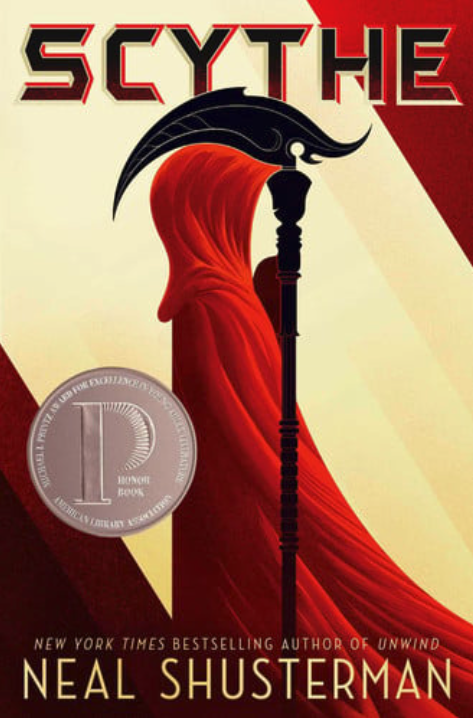
Happy New Year dear listener, we are back and ready for 2026! As the last festivities wrap up, take 10 minutes with me to hear about one of my favourite sci-fi novels: Scythe.
Neal Shusterman is the author behind Scythe and the whole subsequent series. I think this was the third time I read Scythe and let this serve as the true evidence about how good it is. Having read the rest of the series, I can say nothing beats the first one. The next books are good too, but not as good as this one. I think a lot of elements and their combinations make this a 5 out 5 book. Before we explore that, let’s get familiar with the plot.
The events of the novel take place around 2090, I want to say. But in any case, we are after the year 2042, the marking of the end of mortality. We are still on Earth and with the same countries we have now. Humans have invented this artificial intelligence being called the Thunderhead that serves as a omnipresent entity. It has abolished government and essentially presides over humankind (in a good way). The only thing it is not allowed to handle is death. While mortality has been conquered, the Earth’s surface is still limited a a certain number of humans still have to die each year. In come the Scythes, these human individuals above the law that have as a job to kill a certain quota of people each year to curb the exponential growth of the Earth’s population. This first novel starts with Honorable Scythe Faraday taking on two apprentices, Citra and Rowan. We follow their journey as they become part of the elite and navigate this new domain.
Now who is Scythe Faraday? He is a well respected Scythe operating in the MidMerican area and who chose chemist and astrophysicist Michael Faraday as his patron historic. This means that when Faraday became a Scythe, he renounced his birth name and took on the name of an important figure in human history. Of course, these patron historic names characterize each Scythe in their own way. Michael Faraday was a scientist and this shows in Scythe Faraday’s killing methodology. He tries to replicate mortality statistics from the Age of Mortality. For example, during an outing with Citra and Rowan, he tells them that parking lot accidents accounted for 1.25% of deaths and so proceeds to kill (or “glean” as they call it), a woman bagging her groceries in a parking lot. He is a very good embodiment of what a Scythe should be. They should not enjoy killing and be very calculating with how they glean.
Scythe Curie is another famous scythe who also tries to replicate death from the age of Mortality. However, unlike Faraday, she just gleans people unexpectedly and looks for people who look like they are done with life. Her reasoning for this is that quote “In the Age of Mortality, death would often come with no warning. It is our task to mimic what we’ve stolen from nature.”
I find it interesting how the author developed all these ideas about the Thunderhead and what generative AI can do because it’s all eerily becoming true right now.
But the really interesting character is Scythe Goddard. He is part of the “New Order” type of Scythes and while the reader can clearly seem him as the antagonist, his methodology leaves little room for critique. We can see he has evil intentions but given that he follows the 10 scythe commandments, no one can really go against him and some scythes even start seeing reason in his way of thinking. For example, Goddard early in the novel decided to glean an entire airplane. Airplanes really did crash and everyone on board died so it makes complete sense to kill so many people at once. Even if the citizens of this “new world” are scandalized by the killing of so many people at once and think it is barbaric, Goddard, just like Faraday chooses to glean deaths in proportion to how they happened in the Mortality Age. However, he does enjoy this like sport, and it is what makes the reader and other characters uneasy about his methodology. He is a scythe that lives for a scandal as evidenced by his mandatory scythe journal entries. They all start with some outrageous comment that gets us all worked up but then his concluding sentences really remind us that he’s right and that puts a stopper to the objections people might have. For example, he says that all scythes should love what they do, love killing, etc. And this is bad, they should NOT like killing. But then Goddard ends the whole thing by saying quote, “After all, this is a perfect world—and in a perfect world, don’t we all have the right to love what we do?” Of course this is scary but what’s even more worrisome is how his extravagance and radicalism persuades people and makes them gullible. In a random journal entry on eliminating the gleaning quota, his argument is that scythes that want to kill will compensate for the scythes that don’t. And while right now that seems like a good off-setting balance, it doesn’t make sense in the long run. Think about it, why would society have the need for a scythe that won’t kill? There will not be any more apprentices taken on and current scythes will benefit from all the things of being a scythe without having to endure the burden. And of course, if there is no quota, yes it will offset for those that don’t glean, but what is going to stop scythes like Goddard from gleaning a whole plane or train or stadium every day, even multiple times a day? The journal entry ends again with an irrefutable line: “In this way, we can help one another, and isn’t helping our fellow scythes a good thing for all of us?”
While there is a diverse set of characters and explicit mentions of diversity, America stills figures as a trendsetter
Enough with the scythe for now, I still need to talk about a few other characters. Citra and Rowan are both apprentices to Faraday. Both are intelligent, resourceful, and strong-minded. They are competing to become a scythe while the loser will return to normal life after the end of the year. Since they are still novel teens, they have not yet done significant things with the lives or embodied unique philosophies to reveal in this review. Finally, we have the Thunderhead, the central force of this new world. It is a form of artificial intelligence that rules the world in peace, efficiency, and rationality. It has jurisdiction over the whole world except scythe matters. I find it interesting how the author developed all these ideas about the Thunderhead and what generative AI can do because it’s all eerily becoming true right now. Scythe Curie mentions in one of her journal entries that people use the Thunderhead as a confidant and that it’s the world’s best listener. And isn’t that what ChatGPT and all these other GAI are to us right now? How many people confide in it? Very scary given our AI platforms don’t have the privacy level of the Thunderhead.
Now moving on to plot. I though it was great. It moves fast enough to keep the action going while also taking enough time to introduce the setting and put the reader in context. Each chapter is preceded by a journal entry of a certain character that alludes to the topic of that chapter. Good plot twists and continuity so it all reads quite fast. As with most Western literature, the US seems to be very prevalent. While there is a diverse set of characters and explicit mentions of diversity, America stills figures as a trendsetter: “The MidMerican Conclave is an important one,” Scythe Faraday told them, “because we tend to set the trend for much of the world.”
I’ve talked about the world building before and how well executed and interesting it is. The last bit I want to share with you is about the duality of being a scythe. While everyone else gets revived if they died (unless gleaned), scythes cannot be revived unless foul play. They are very vulnerable in that way and shows the duality that seems to exist throughout their whole life. They are the most powerful position in society, yet they are not automatically revived like normal people and have to make sure they don’t die accidentally. They are also not under the Thunderhead and must resort to internal flawed human governance. They are the takers of life and thus must not enjoy taking it when everyone else is morally understood to like their job and take pleasure from it.
We are at the end of the first 2026 episode. Thank you for starting the year with me! Don’t forget to set your reading goal for the year and I hope you’ll surpass the one from 2025. Next month, I’ll be talking about a non-traditional love story so make sure to add One Italian Summer to your February TBR.
Until then, keep exploring those pages!
– reviewed on January 1, 2026