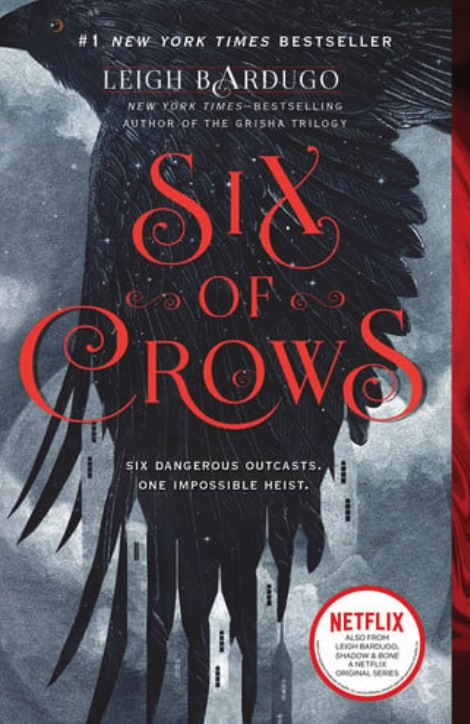
Six of Crows


Welcome back! I’m so happy to be talking about a favourite book of mine, Six of Crows by Leigh Bardugo. As you can guess, it’s obviously a re-read so take that as a sign to add this to your TBR.
Leigh Bardugo is the author begins all the Grishaverse novels including the Shadow Bone trilogy as well as the King of Scars and Six of Crows duology. This “Grishaverse” serves as the setting for these three series and a few other novels Bardugo has published. So before we get into the Six of Crows plotline and review, I’m going to provide you with some background into this complex setting.
All these novels are of the fantasy genre but the setting resembles closely countries and cultures we have across the world. First we have Ravka, a country that plays on Russian culture, religion, and history. For example, Ravkans believe in divine saints, their language and character names resemble the Russian language, and Ravka is geographically located where Russia would be relative to other counties. Its climate and environment is just as harsh and cold as Russia. A particular feature of Ravka is that it is the only country in the Grishaverse to welcome and embrace Grishas. What are Grishas? They are humans but with heightened senses that allow them to manipulate natural elements such as air, water, materials, and the human body.
Next, there’s Ketterdam a city within Kerch, which as you can guess from the name, sounds like Amsterdam. Just like the capital of the Netherlands, Ketterdam is full of canals, boats, ports, and narrow streets. It’s also a mix with New York’s business-like atmosphere with financial markets and trading playing an important role. This is the setting for Six of Crows. Other countries include Novyi Zem representing a mix of the Americas and Africa, Shu Han as East Asia, and Fjerda as the Nordic Countries.
I know this is a lot to take in, so for the context of Six of Crows, just remember Ketterdam, the trading hub. Before we get into the summary, I really want to mention how detailed and crafty the world-building is. Leigh Bardugo did a great job, the descriptions are vivid, and the world she created is not too far from our own reality, but just separate enough to feel like another dimension.
The main characters are equally presented and featured, unlike other fantasy novels that figure a central main character
So what is Six of Crows actually about? Well, we embark on this recovery mission with Kaz Brekker and his crew to extract a Shu Han scientist from the main Fjerdan stronghold. This guy invented a way to alter the chemical composition of jurda, a stimulant plant, and this alteration enhances the abilities of Grishas. So Kaz is kidnapping this scientist to bring him back to Ketterdam for Van Eck, the guy who sent Kaz out on this “heist” as they call it.
The novel is advertised as being along the same lines as Ocean’s 11 because they’re both heist stories. I simply don’t see it that way. Ocean’s 11 to me is a really light movie that’s super fun to watch because the main focus is on the actual heist, the plot. Six of Crows is deeper than that. We spend a lot of time getting to know the characters, what drives them, what their backstory is and how they all fit together. This is not a bad thing, I just don’t think it’s the best comparison. I see this story as a quest given the “magical” atmosphere and the character backstories.
But just like a good heist story, Kaz is a sharp and smart leader. He’s brilliant, he really thinks of everything and that makes him special is that he thinks so much in advance and has so many contingency plans that we the readers would have never considered. It’s like he gets insurance for his insurance. And it’s not just pure luck or really stretched out scenarios. He’s truly a crafted strategic planner and his execution is very smooth and natural. Now Kaz might be the leader of the crew, but everyone on the team is just as important and their skills compliment each other very well. I like that the main characters are equally presented and featured, unlike other fantasy novels that figure a central main character, a “chosen” one with sidekicks. But if you like the singular main character stories, Shadow and Bone is perfect for you. I’m actually gonna use this opportunity to recommend you read Shadow and Bone before Six of Crows because of references to characters from that trilogy. If you read it before Six of Crows, you’ll also get familiar with Grishas and the setting seeing as Shadow and Bone was the first series to have been published in this universe. You can still read Six of Crows first, but you’ll miss Easter eggs and nods to Shadow and Bone characters and events.
The history slowly starts coming out in little bits as we progress through the story, but I wish it would have come out in one big burst.
The rest of the crew consists of Inej, a super talented acrobat that gathers secrets for Kaz, Jesper, a gambling addict with precise shooting abilities, Nina, a talkative and confident Grisha, Matthias, a former Grisha hunter, and Wylan, a young explosives expert.
For all its cleverness, I will say I find it quite unbelievable that a bunch of 17-18 year olds are trusted to make this mission work. Yes, they “had to grow up fast” and adjust to the harsh gang life present in Ketterdam. They had to get smart and fast, but still. They are beating out military men and fighting off forces so much stronger and powerful than them. It’s really easy to forget they are essentially kids. I think the story would have been a touch more believable if they were in their mid-20s.
This last point I want to make is quite subjective and it’s a matter of “is this your style/preference” or not? I don’t like novels when I have to wait half-way through the book ( or even the end sometimes) to find out the truth or a secret a character has been keeping. Of course, this serves as an incentive to keep reading the book and get through the pages, but I think we often forget details and moments related to this “mystery” as we read on because we have nothing to anchor it to. In this context, Nina and Matthias clearly have a messy backstory and they keep alluding to it, but it makes no sense to us because we have no idea what they’re taking about. Their history slowly starts coming out in little bits as we progress through the story, but I wish it would have come out in one big burst. Like maybe Nina would have gotten mad at Matthias and lashed out their conflict so we can have some clarity.
All in all, super great book. 4 out of 5 stars. This series also has a definite ending with the second book, Crooked Kingdom, as the last instalment so you know it’s not going to go on forever and lose its spark. I hope you enjoyed April’s episode and make sure to follow The Exploring Reader on Apple Podcasts or Spotify to not miss out on the May review of Wild Dark Shore by Charlotte McConaghy. Until next time, keep exploring those pages!
– reviewed on April 1, 2026