The Things They Carried

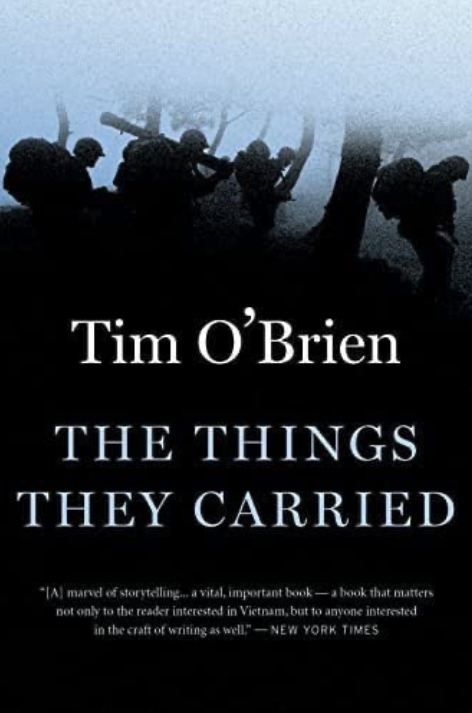
Hello! I’m glad you could join me for the March episode on The Things They Carried by Tim O’Brien. If you love historical fiction laced with truth about personal experience, you need to add this is the book to your TBR list.
O’Brien first published the novel in 1990 and the events were inspired by his own time as a solider in the Vietnam war. Its impact reverberated through many readers and the book became a Pulitzer Prize finalist a year later.
While many events and places the author describes are real, the story is still fictitious at its core. The events follow the Alpha Company platoon as they navigate their way through various Vietnamese villages. It deals with the physical and mental challenges soldiers face during any war: ethical dilemmas, trauma, violence, paranoia, etc. The narrator lays out his interactions with his squad, but also his life after he came back. This novel is heavily centred on characterization, with each action of the plot adding to how the narrator reacts to it and how he decides to interpret the truth.
I think this is a wonderful story and it deserves 5 stars because it skillfully blends the line between fact and fiction. The narrator himself emphasizes that the truth is relative and this recruiting theme will definitely make you question what was real and what was not. I do believe this book’s lesson goes beyond the typical “war is bad” and rather focuses on consequences of creating our own narrative, of forsaking reality. And of course, to achieve this, the author had to use a lot of imagery. The harsh and violent descriptions helped forge the truth as the narrator saw it. Since this is a war story, I think it was necessary to keep the details, the descriptions, to focus more on how it feels to live and survive a war, rather than keep the plot moving. I felt it was also tedious to talk about all the places they visited because it was always the same actions: invading, fighting, killing, burning, moving on, etc. Usually when a story has static characters, it appears bland or uncompelling. In The Things They Carried, it worked to its advantage because in a quickly changing environment, it’s good to rely on something stable, to count on your friends and their consistency. I can imagine the war was very traumatic and all the characters emerged changed from their experience, but I felt that most of them kept their personality and when they returned home, they just returned as themselves but with more trauma. For example, Rat, the medic, would always embellish stories despite the already unimaginable events he lived thought. The rest of the platoon knew he was lying, but they let him go on because they felt comfortable, and Rat kept going because it was what kept him going during war time. In terms of the point of view, I liked that it was focused on the narrator because it would have been overwhelming to shift point’s of view.
The narrator himself emphasizes that the truth is relative and this recruiting theme will definitely make you question what was real and what was not.
Furthermore, no one can tell a story better than one who has lived through it. The structure is equally well done because the shifting between different parts of the plot remind me of the flashbacks that soldiers often experience when they have post-traumatic stress disorder, or PTSD. The chapters are structured around a non linear plot line, and each one focuses on a main event that happened either in Vietnam, or the United States when the soldiers came back home. I think it’s a good compromise between short and long chapters, you can definitely adjust to it if it’s not you typical reading style.
The book’s title leaves us to ponder on the physical things the soldiers carried like their rations, equipment, weapons, tents, souvenirs and also the mental things they carried, the burden of knowing what it is to kill someone, to live in atrocious conditions, to realize that you are alone in knowing what all of this feels like.
I know this book is taught in certain schools and some of novels are not always a hit, but one is. Of course, it does contain some gory details and descriptions about various levels of violence, but do try to give it a go because the book possesses great emotional depth.
Thank you for listening and until the next review, take the time to appreciate Tim O’Brien’s war story. The April episode will be on a contemporary fiction novel, Commonwealth, written by Ann Patchett.
Until our next literary journey, keep exploring those pages!
– reviewed on March 31, 2024