Trust

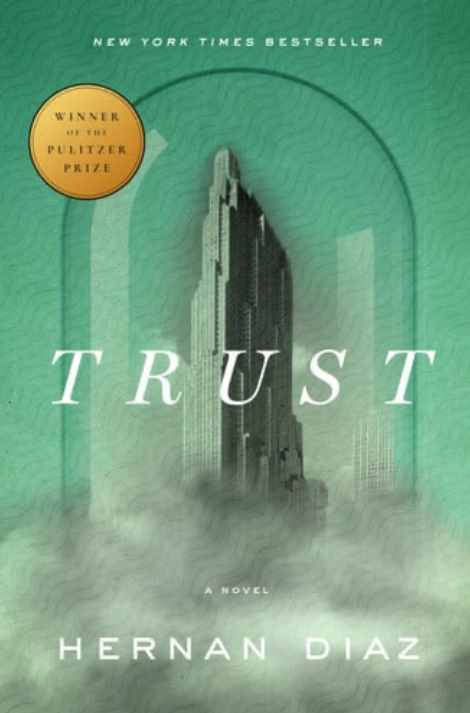
It’s Christmas time everybody! The best time of year in my opinion. I am super excited about this Exploring Reader episode so you go make that hot cocoa while I tell you why next time you go out, you have to get your hands on the December pick: Trust by Herman Diaz.
I didn’t know it was going to become a HBO limited series when I decided to read it. I found out when planning this episode and digging into the author’s other works. Apparently we’re gonna have Kate Winslet as a director on this like okkkk I can get on board with this. HBO is stepping up their game! If you recall, they are also producing the TV adaptation of Everyone In My Family Has Killed Someone, so make sure to check out that episode. Now back to Trust, the author published it in 2022 and it received multiple awards like the Pulitzer Prize for fiction and the Kirkus Review among others. In an interview with the Ballerina Book Club, Diaz mentioned he chose the idea of trust and capitalism as the focus of his book because of how money is a quote “conventional fiction with all-too-real consequences”. And I think he’s right. Money has value as he explains because we trust it has value and that it will enable us to access goods and services. He also did an interview with The Paris Review and I feel like the more I read about his work and remember the novel, the more I feel like the word “Trust” and the theme are so perfectly chosen because everything is like interconnected and has a clear connection with the themes. Before we get into that, let me give you some context on the plot.
The novel is divided into 4 parts, with each one being a document written by a different author. While they are all relatively about the same story, they tell it from different perspectives and also different times in the narrative. The plot lines all revolve around a man named Andrew Bevel, a legendary financial investor. The individual novels follow his path to fame, his many impacts of the American economy, his personal life and they all talk about themes such as money, trust, wealth, perceptions, power, and influence.
I definitely found this novel refreshingly original and 100% deserving of the Pulitzer win. The creativity was really on point and I was not bothered by the multiple POVs retelling the same story through different lenses. I actually think that each brought a fresh take on a part of the story that was omitted by the other 3. I liked the complexity of the novel, how it was up to the reader to identify the biases of each storyteller and try to find out the truth and figure out who to trust to tell the real narrative. And the beauty of it is that they all are telling the truth and changing it at the same time so that you need all 4 stories to be more confident in your perception of events. I think Herman Diaz came up with an incredible way of showing the impact of subjectivity, its limitations and possibilities. Telling your own story gives you the possibility of providing details and proof others don’t have access to. However, you can also embellish it and shape the truth to show you in the way you want to be perceived. The downside of others telling your story for you is that they can misinterpret situations, but they can also add a filter of objectivity because they tend to research facts and pool together cohesive events to create a story.
I think Herman Diaz came up with an incredible way of showing the impact of subjectivity, its limitations and possibilities.
The complexity and continuity of the plot structure alone are the reasons this book deserves and needs a re-read. While there is a flow and the story advances, there are many references to the past without it being a flashback. I think it might reflect how financial traders often rely on historical data to place trades and engage in different investment opportunities. The question is, do the traders trust the historical information enough to use it as a foundation for their predictive model? And you wanna talk more about this interconnectedness? The different terms used throughout the novel all have a double meaning. The first document (or actually, it’s more of a novel) is called Bonds. Now this word can be used to signify the different bonds or relationships that people have with each other. This can be family, romantic attractions, business partnerships, etc. But bonds are also a type of investment product where a lender gives out money to a borrower and the latter promises to pay back the original amount lended + some interest. I think this is so clever because the same word invokes the same principles but in 2 different things. When you have a bond or connection with someone, we often talk of an unbreakable bond, but bonds can be broken and trust can be revoked. Well the same goes for financial bonds. They are considered a very safe investment with low levels of risk, indicating confidence. But they are not infallible and some of them can be revoked. The second part of Trust is called Futures. Again this word has 2 meanings. It can literary signify the state in time of what will be. This implies possibilities and the unknown. But…futures are, yes, another financial product. Contrary to the literal meaning, financial futures are contracts established to curb and reduce uncertainty. They are traded in order to create predictability in the future price of a certain stock or commodity. They are there to establish trust among the parties involved. Think of it like a baker agreeing to pay a wheat farmer x-amount of money for y-amount of wheat on a date in the future. The baker trusts that the farmer will deliver the exact amount of wheat and for that, he will pay the agreed upon price.
It’s one of those rare gems that is becoming harder and harder to find in literature these days.
I will end the segment by saying how I loved the subtlety with which the author differentiates the female and male characters’ perception of themselves and others. The men tended to have grandiose visions, visions that they were part of a bigger collective and that they were not just impacting themselves, they were also impacting society. While it seems they never truly believed they alone could accomplish such big things, they believed the bigger “collective” they belonged to could not function or succeed without them. In contrast, the women of this story felt solely responsible for what was happening to them and they take all the credit for all they accomplished. They don’t seem to have grandiose visions of being famous and well renowned, but they believe they alone are what led to their success (of course with some help). In brief, the men thought big thoughts and that they were part of some greater group while the women were more individualistic but focused on smaller successes in their own lives.
Nothing is ever without flaws and Trust is no exception. While its complexity does provide it with beauty, it also makes it hard to follow. It might take you longer to read because you have to go over some passages again and analyze and take apart the story. You might very well have to read it a second time. If you’re not big on analysis, that’s fine, you can still read it but you might miss some enhancing characteristics especially in the last part of the novel. It’s more of a diary with notes and comments rather than grammatically correct written text. The writings are erratic and show the declining state of that final author. I feel it requires more concentration and attention to decipher which is exhausting. So beware! But after all, we are reading for pleasure here not trying to write a thesis.
So you be the judge, think on it and decide if it’s the kind of book for you. If not, maybe gift it to someone you think will appreciate it more because it truly deserves to be read and it’s one of those rare gems that is becoming harder and harder to find in literature these days. If I sit here and think for a second, it feel like a Christopher Nolan movie. I’m thinking of Inception, Tenet, I had to watch those at least 3 times each and I still randomly think about them sometimes. So that’s a good indicator of how you should feel about Trust. If you sat and watched Chris Nolan movies many times, this is like the perfect novel for you.
Well, this wraps up the last episode for 2024! I wish you wonderful holidays and a Happy New Year. Join me in welcoming 2025 with your pick! I will truthfully tell you what I though of Taylor Jenkins Reid’s The Seven Husbands of Evelyn Hugo. Until then, keep exploring those pages!
– reviewed on November 30, 2024